
The more experience you gain as an artist, the more you rely on familiar ways of getting good results. You know exactly where to start. You choose your favorite brush from the “My Brushes” folder, build the forms, paint the fur, add the final details and the piece is ready to share.
Everything seems perfect until one day you realize that you have been following the same path again and again.
That was when I discovered Wouter Tulp’s Digital Painting Workout on Schoolism. The course is a series of short exercises designed to help artists step away from their usual process and explore different ways of painting.
It includes 63 exercises divided into nine sections, with each one taking around 30-40 minutes. Wouter encourages artists to experiment with value, color, light, shape design, brushes, and other tools. In the final section, all these subjects come together.

I completed the course independently, without feedback from the instructor. At first, I followed the recommended schedule, but towards the end, I began moving faster and sometimes completed several exercises in one day. My record was seven.
I wouldn’t necessarily recommend following my example. Focusing too much on speed can make the practice less effective. I wanted to see the course as a whole and then move on to my own experiments. But if you want to explore each subject in depth, one exercise a day is probably the better approach.
What I liked most about the course was how Wouter encouraged artists to experiment without taking every sketch too seriously. Not every attempt has to work. You can simply try a different approach and keep exploring.
The exercises were very different. In one, I built an entire sketch from bright shapes. In another, I used an unfamiliar textured brush to paint hair. I also experimented with limited palettes and exaggerated forms. Some exercises confused me at first. Painting with Sargent-inspired brushwork, for example, took me much longer than thirty minutes. New brushes looked easy to use in Wouter’s demonstrations, but when I tried them myself, I suddenly had many questions.
Gradually, I realized that tools can do more than help you carry out an idea you have already planned. A brush, texture, or shape can suggest where to go next. A reference can guide your approach or inspire you to try something completely different.
The section on textured brushes was especially useful for me. Before the course, I mostly used them at the end of my process to add texture and break up areas that looked too smooth. This time, I tried starting directly with texture and skipping my usual clean sketch.
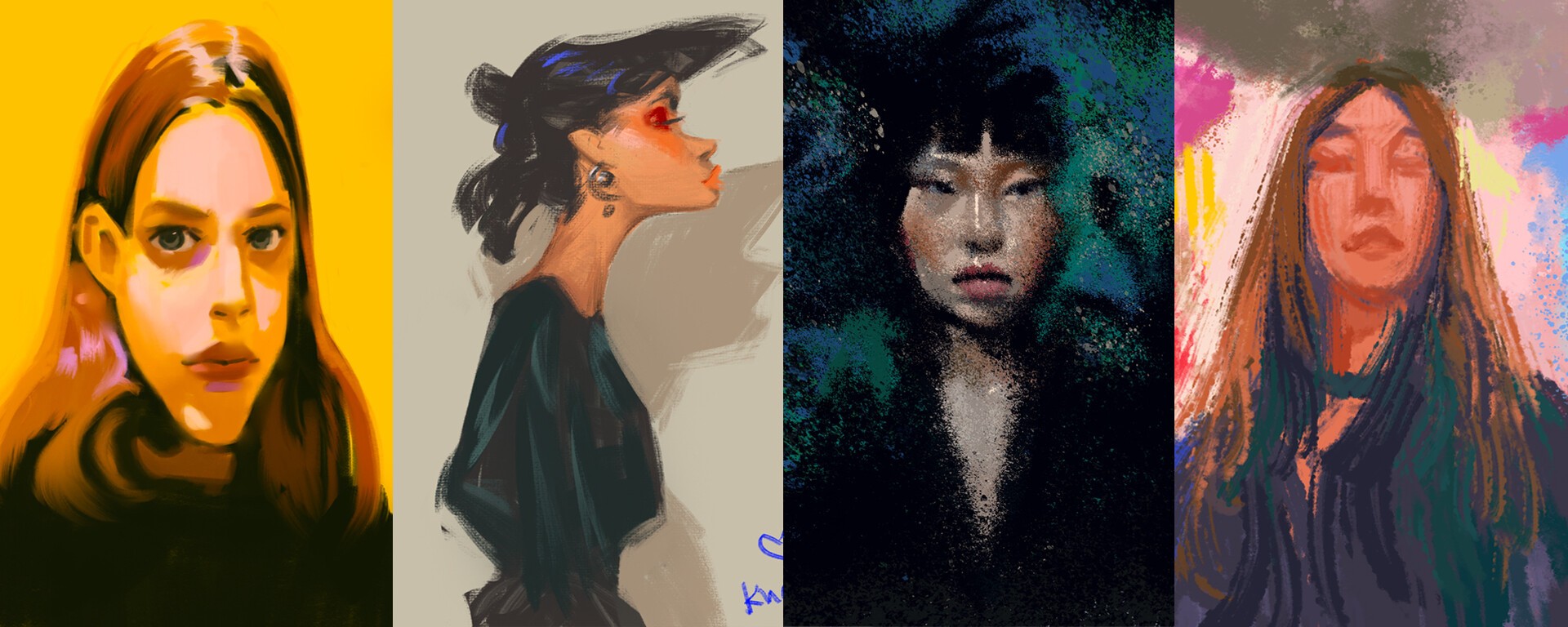
In one exercise, random edges and marks became the starting point for the image. Instead of planning the silhouette and then filling it in, I searched for forms within the texture already on the canvas. I developed the parts that worked, removed the rest, and allowed my original idea to change along the way. The result was less predictable, and the process felt far less mechanical.
Not every technique became part of my regular process. Some simply didn’t suit the way I work. But now I know that because I tried them, not because I dismissed an unfamiliar tool before giving it a chance.
Another important change came from working within a time limit.
With only 30-40 minutes for each exercise, there was no time to keep correcting the drawing, trying endless variations, or polishing every detail. I had to decide quickly what mattered and what could be left out. This changed the way I judged my sketches. Before, a successful sketch was mainly one that looked good. But when the goal is to test a new brush or explore a different way of working with shapes, even a strange-looking result can be useful.
Did the technique work? What went well? Where did it fall apart? Do I want to try it again?
If I can answer those questions, the time was well spent.
This approach also reduces the fear of making mistakes. You don’t have to rescue every sketch or turn it into something worth sharing. Sometimes it is simply an experiment. It may fail and that is fine, because the next one begins in thirty minutes. I recommend saving every exercise, including the unsuccessful ones. Looking back makes it easier to see what was difficult at first and what changed after a few attempts.
After the course, I kept making quick sketches, but began giving each one a clear goal.
Before I start, I decide what I want to test: a new brush, a limited palette, unusual shapes, a different style, or a way to move further from the reference. I write the question directly on the canvas to keep it in mind while I work.
Can I build a portrait using only large shapes? What happens if I start with texture? How far can I push the proportions or color before the image stops working?
I give myself no more than an hour to find the answer. The goal is not to create a polished image, but to understand what works and what doesn’t.
Now every sketch has a purpose. Some ideas are worth exploring further; others are not. Either way, I know why I made the sketch and what I learned from it.

As AI became a larger part of my professional work, drawing gradually moved into the background. At some point, the line between creating something myself and simply directing an AI tool began to blur. My process was becoming a cycle of generating images and photobashing the results.
Digital Painting Workout brought me back to drawing, finding my own solutions, and feeling more in control of the process.
I still use AI, but I am more careful about what I delegate to it. It can support the process, but it shouldn’t replace creative thinking. Like any tool that offers easy answers, AI can make it tempting to stop asking your own questions. The challenge is to keep asking them because those questions are what move the work forward.
Digital Painting Workout is best suited to artists who already know the basics of drawing and digital painting but feel that their process has become too predictable.
Some exercises may be challenging for beginners. Wouter gives each experiment a direction but doesn’t always explain why a result isn’t working. Without solid fundamentals or feedback, it may be difficult to get the most out of the course. If you always use the same brushes, begin every sketch in the same way, and already know roughly how it will turn out, it may be time to try something unfamiliar.
I’m glad I completed all 63 exercises, even though many of them didn’t look good. The course is over, but the experiments continue.
